
Geopolitical escalation and the global services spending reset

Middle East Conflict
When risk rises, spend shifts – the Middle East conflict and global services
Navigating global uncertainty?
Escalation in context
The US-Israel-Iran conflict has moved into a more overt, state-to-state military phase, with sustained air and missile activity as well as widening maritime and regional spillover. Reporting over the past few days points to an expanding operational envelope: continued missile and drone launches, strikes against strategic assets, and a more visible US military role that now includes direct naval action beyond the immediate theater.
A critical escalation marker is the effective disruption of commercial navigation through the Strait of Hormuz. Vessel traffic has dropped sharply, ships have anchored in surrounding waters, and major shipping and insurance organizations are treating the risk environment as persistent rather than transient. Multiple leading marine insurers have moved to cancel or reprice war-risk cover, and war-risk premiums are rising rapidly, thus increasing costs of energy and freight, independent of any physical shortages. In energy markets, Brent has continued to fluctuate between $80-$115/bbl, underscoring that prices reflect expectations and policy signals as much as immediate physical shortages.
From a strategic standpoint, Iran’s leadership posture historically emphasizes deterrence, regime security, and the ability to impose costs through asymmetric tools: missile forces, drones, proxies, and disruption of chokepoints. In that context, a prolonged confrontation is not an outlier scenario; it is a plausible baseline, particularly if Tehran interprets ongoing strikes as threatening core regime stability.
For organizations and service providers, the key context point is that escalation pathways now include not only continued standoff strikes but also cyber disruption and an elevated tail risk of ground involvement. Official messaging indicates there is no declared plan for US ground troops, but no option has been ruled out, increasing uncertainty.
Macroeconomic transmission: energy, inflation, and growth
The conflict is disrupting global energy and shipping flows. Tensions in the Strait of Hormuz are tightening oil supply, increasing oil prices, and raising freight and insurance costs. These higher costs are contributing to inflation in both advanced and emerging markets. Higher energy prices are affecting monetary policy and growth. As inflation risks re-emerge, expectations for monetary easing are being pushed out, increasing the risk of a higher-for-longer rate environment and softer GDP outcomes. Emerging markets, particularly energy importers such as India, face currency pressure and slower growth. Japan, Europe, and the UK are exposed through inflation pass-through and real income compression, weighing on demand. The US is relatively less exposed given domestic energy production, though higher fuel costs still dampen consumption.
Freight inflation and insurance repricing are driving higher working capital requirements, and planning cycles are becoming more conservative. Growth expectations will soften as margin compression spreads across energy-intensive and trade-exposed sectors. Stagflation risk is entering board-level discussions as business leaders consider the possibility of prolonged disruption. The ultimate magnitude of impact will depend on conflict severity and duration.
For companies, this environment is influencing capital allocation and technology investment decisions. CIOs and CFOs are prioritizing cost discipline and adopting a measured approach to long-cycle discretionary transformation programs. The shift is observable in sectors most directly affected by supply chain and energy disruption.
Scenario outlook and business impact
In a fluid conflict environment, the most practical way to plan is to anchor on defined escalation pathways and the business signals they trigger. Exhibit 1 outlines three scenarios, linked to observable military and maritime developments, and translates them into oil/market signals, expected organization behavior, and downstream implications for services demand and provider commercial risk. The intent is to support decision-making based on duration and severity rather than day-to-day headlines.
Exhibit 1: Conflict escalation scenarios and business impact pathways
Source: Everest Group (2026)
| Contained but prolonged conflict |
Sustained regional disruption |
Expanded war and structural geopolitical shock |
|
| Current scenario | Moderate-probability | Low-probability | |
| Escalation triggers | Missile/drone exchanges continue but remain contained to primary actors; Hormuz operates under escort / intermittent disruption (not full shutdown); no sustained attacks on major export infrastructure; proxy activity remains limited; no ground campaign
Conflict horizon: <10 weeks at bounded intensity |
Hormuz disruption persists for weeks, and commercial flows fail to normalize; war-risk insurance withdrawal/repricing remains elevated; repeated incidents drive rerouting; partial constraints on energy/LNG exports or infrastructure disruptions emerge; proxy activity widens across the region
Conflict horizon: 10-18 weeks with regional disruption |
Multi-front escalation with sustained infrastructure targeting; extended Hormuz disruption; ground involvement risk materializes; explicit regime-destabilization signals or internal instability; sustained cyber/critical infrastructure actions
Conflict horizon: >18 weeks with high global disruption |
| Oil & market signal | Brent sustained monthly average <$95; freight and war-risk insurance elevated but functional | Brent sustained monthly average $95-$120; freight inflation; easing delayed; growth weakens | Brent sustained monthly average $120+; structural supply shock; global growth contraction; stagflation risk elevated |
| Company behavior | Boards cautious but no freeze; slower approvals; tighter ROI scrutiny | CFO-led cost control; vendor consolidation; phased transformation; capital gating | Structural cost discipline; transformation budgets cut or re-baselined; hiring freezes in some sectors; CapEx materially reduced; geographic risk diversification accelerates |
| Company spend impact | Shift toward cost optimization and managed services; mild elongation of large programs | Discretionary transformation slows; spend shifts to automation/cost-out and resilience | Transformation budgets reset; multi-year productivity and resilience programs dominate; large AI transformation gets delayed significantly |
| Margin & commercial risk for service providers | Moderate pricing scrutiny; manageable margin pressure | Visible pricing pressure; utilization risk in discretionary practices; EBIT compression risk | Significant year-1 margin compression (pricing + utilization + wage pressure); restructuring risk in consulting-heavy portfolios; in years 2 to 3, structural annuity expansion for firms positioned in cost and resilience |
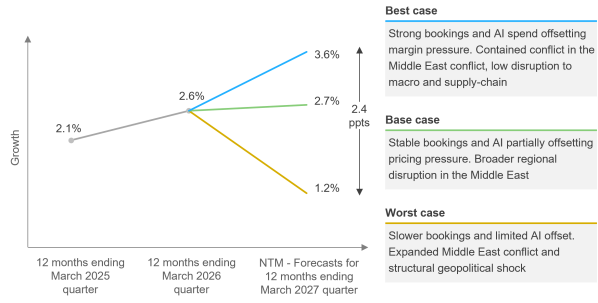
The macro backdrop matters most insofar as it influences company budget posture and bookings momentum in the services market. Exhibit 2 illustrates how different escalation outcomes can translate into materially different growth trajectories for the global third-party services industry. The spread across scenarios underscores the swing factor for the market: whether disruption remains contained, becomes a sustained regional constraint, or evolves into an extended structural shock that materially tightens discretionary spend and conversion rates.
Exhibit 2: Global third-party services growth outlook: market conditions and conflict escalation scenarios
Source: Everest Group (2026)
Sector impact: margin and demand shifts
Sector impact will be uneven, and the scale of margin pressure and spending reprioritization will vary based on the conflict’s evolution across the scenarios outlined earlier. Exhibit 3 provides a baseline view of sector exposure, indicating where disruption is most likely to translate into tighter spending versus where budgets are likely to remain resilient.
Exhibit 3: Sector sensitivity overview
Source: Everest Group (2026)
| Impact profile | Sectors | What shifts first (organization lens) | Near-term demand themes (services lens) |
| Relative tailwinds
protected spend |
Energy & utilities; aerospace & defense | Security, reliability, and mission-critical programs stay funded | Cyber resilience & managed security; industry ops modernization; managed services expansion |
| Most impacted
margin and disruption pressure |
Travel, transport & logistics; insurance (incl. marine); manufacturing (incl. industrial/auto); retail & CPG | Margin defense and operational stabilization; working capital pressure rises | Cost takeout & productivity; supply chain resilience; managed services / run optimization; customer operations continuity |
| Moderate / mixed impact efficiency and risk-led reprioritization |
Banking & financial services; telecom, media & tech; healthcare & life sciences; public sector | Efficiency and risk programs prioritized; discretionary initiatives more gated | Risk, compliance & financial resilience; cloud cost governance (FinOps); managed services/run optimization; cyber resilience; customer ops continuity |
This view of sector sensitivity is directional rather than static. In a more contained scenario, impacts tend to be selective and time-bound; under sustained disruption, reprioritization broadens as inflation and freight pressures persist; and in a structural shock scenario, budgeting and investment decisions are reset more materially. The common thread across scenarios is that funding increasingly concentrates around near-term cost, resilience, and operating outcomes, while longer-cycle discretionary initiatives face higher scrutiny.
Implications and priorities for companies and service providers
The current environment is beginning to influence capital allocation thinking, cost discipline, and services demand. Five implications are likely to shape organization and provider decisions if disruption persists.
-
1. Spending scrutiny is likely to increase, particularly for discretionary transformation
Energy inflation, freight volatility, and softer growth expectations will likely raise approval thresholds for multi-year digital reinvention programs. Boards and CFOs may place greater emphasis on near-term ROI and defensible business cases, especially in sectors most exposed to supply chain and energy disruption.
-
2. Cost discipline and resilience are likely to move to the forefront
Organizations are expected to prioritize automation, managed services, supply chain resilience, and initiatives with measurable productivity and working capital impact. Programs framed around operational continuity and risk mitigation may progress faster than growth-led transformation initiatives if uncertainty persists.
-
3. Revenue mix may rotate rather than contract
For service providers, demand is likely to shift toward resilience-led and operational efficiency offerings, including automation, cybersecurity, and run optimization. Consulting-heavy, long-cycle transformation portfolios may see slower conversion and elongated sales cycles under sustained disruption, but the shift would represent reprioritization rather than broad demand erosion.
-
4. Cost and margin vigilance will become more important for both organizational buyers and service providers
Organizations optimizing costs will closely examine services pricing, contract structures, and productivity commitments. Providers, in turn, will need to balance pricing discipline with competitiveness while monitoring wage, inflation, and currency movements in key delivery markets. Currency depreciation in markets such as India may partially offset cost pressures in the short term, but business leaders should factor volatility in both inflation and FX into planning.
-
5. Second-order operational risks warrant monitoring
Sustained energy price increases will affect AI-intensive workloads and cloud infrastructure economics. Travel disruptions, mobility constraints, and heightened security posture in parts of the Middle East may also affect on-site transitions and governance cadence for some programs. While not systemic at this stage, business leaders need to evaluate these factors in continuity planning.
Scenario-aware planning and disciplined capital allocation will be central to maintaining stability and capturing opportunity amid prolonged uncertainty.