
Work intelligence platforms enabling continuous workforce evolution in the AI era
As Artificial Intelligence (AI) reshapes work faster than most organizations can track, a new category of platform is emerging. These platforms help enterprises move beyond job-level thinking toward a more granular, task-level understanding of their workforce.
In our recently published Innovation Watch: Work Intelligence and Workforce Redesign 2026, we assessed the leading providers in this space. Our findings point to a market at a true inflection point, with a small but growing set of providers beginning to pull ahead.
The core challenge is straightforward: job titles no longer serve as a reliable unit for analysis in AI-driven workforce strategy. AI is reshaping work at the task level, determining which activities require humans, which can be augmented with AI tools, and which can be fully automated. Yet many enterprises are making high-impact decisions about AI deployment without a clear view of what tasks actually exist within roles, who performs them, and how much effort they require.
Before deciding where AI should be implemented, organizations must first answer a more fundamental question: what work do we actually have, and do we have reliable data to act on it?
Reach out to discuss this topic in depth.
The visibility and design gap
Fragmented data across Human Resources (HR) systems, inconsistent task definitions across geographies, and the absence of a common work taxonomy translate to AI exposure assessments built on incomplete foundations.
Several providers are addressing this gap:
- TechWolf pulls live signals from actual enterprise workflow systems to reflect how work is actually performed, not just how it was designed, a distinction that matters enormously when making automation decisions
- Beamible enables organizations to build customizable, organization-specific work models from lightweight inputs without requiring deep system integration. This makes it particularly well-suited for organizations that want to move quickly into diagnostics before committing to a larger platform investment
- TalentNeuron combines large-scale labor market data with internal job architecture to create normalized role benchmarks, helping organizations identify misalignments with market realities
Once task-level work visibility is in place, the next step is to assess how these shifts reshape roles and organizational structures. In 2026, as agentic AI moves from experimentation into deployment across enterprise functions, an essential question emerges: how will humans and AI work together? Organizations must define which tasks should remain with humans, which are handled by AI agents, where oversight is required, and how accountability is maintained when outcomes are shared.
Key providers supporting this transition include:
- Phenom, which integrates labor market data, company context, and internal talent signals to assess how tasks and roles may evolve, and build development pathways for employees in affected roles so that human capability keeps pace with the work being redesigned around them
- Orgvue models the organization as an interconnected system of people, positions, roles, work, and skills, to address the governance challenge. Its digital twin capability gives enterprises a structured environment to simulate restructuring decisions before implementation
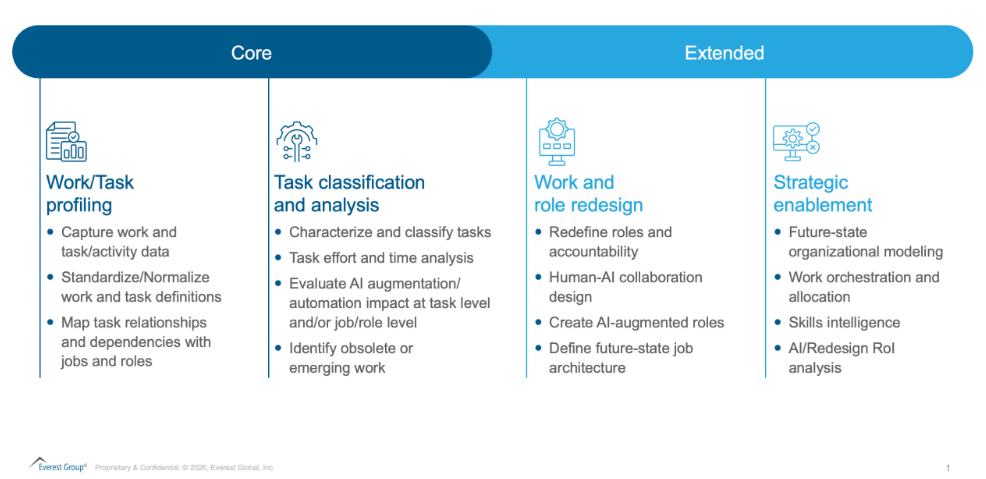
To make sense of how these capabilities come together, it is helpful to view work intelligence as a capability stack. Exhibit 1 illustrates how work intelligence spans from task visibility to workforce orchestration.
The continuous reinvention imperative
Even organizations that address the visibility and design challenge often treat work intelligence as a one-time project. However, this approach no longer works. With AI capabilities evolving rapidly, often on a quarterly basis, a workforce redesign based on a single snapshot can quickly become outdated.
The organizations beginning to stand out from their competition are those treating work intelligence as a continuous operating capability, one that refreshes as AI evolves, the business changes, and new automation thresholds emerge. Reejig exemplifies the continuous reinvention model most directly. Its platform is designed to iteratively measure, redesign, and redeploy work on an ongoing basis rather than as a one-time initiative. It explicitly targets closing the loop between redesign decisions and live operational execution, so that work architecture choices translate into reality rather than remaining as static documentation.
The window for advantage is open, but not indefinitely
In 2026, most enterprises are still early in this shift. Work intelligence as a category is still emerging, provider capabilities are still maturing, and enterprise understanding of best practices is still forming. This creates a meaningful, but limited window for advantage.
The organizations that gain a lasting advantage will not simply complete the most comprehensive one-time redesign. They will build the infrastructure, governance, and organizational muscle to keep adapting work as AI evolves.
Job descriptions are not going away, but as the primary lens for enterprises to understand and manage their workforce, they have reached their limits. The next frontier is not simply better job architecture or deeper task analysis. It is a smarter, faster, and more adaptive relationship with the work itself.
Click here to view our Innovation Watch report on Work Intelligence and Workforce Redesign which can help enterprises understand the trajectory of this category, the leading providers in this space, how they are positioning themselves, and what kinds of capabilities are likely to matter most as work intelligence moves from task analysis into broader workforce transformation.
If you enjoyed this blog, check out, How To Achieve the Promise of Generative AI – Everest Group Research Portal, which delves deeper into another topic relating to AI.
If you would like to continue this discussion or learn more about our research, please contact Sharath Hari ([email protected]), Ishaan Gambhir ([email protected]), and Abhishek Kar ([email protected]).