
Visual AI agents: the next frontier in agentic CX

For the last decade, Customer Experience (CX) has been busy finding its voice. Enterprises have taught chatbots to talk, copilots to suggest, and Large Language Models (LLMs) to reason across knowledge bases. But here’s the uncomfortable truth: most customer problems don’t start as tidy sentences. They start as a blinking router, a cracked screen, a confusing meter reading, a mysterious puddle under the sink, an error light that only appears at that angle, in that lighting, right when the customer is already irritated. Customers don’t want to describe the problem. They want to show it.
This is paving the way for Visual Artificial Intelligence (AI) Agents – multimodal, perception-enabled AI systems that combine vision, language, and reasoning to interpret the physical environment and guide users with precision. As enterprises evolve toward AI-first operating models, visual agents are emerging as the next major unlock for efficiency, accuracy, and seamless experiences across service, support, and sales.
Why CX needed eyes
Traditional CX systems have been optimized for what’s easy to capture: text and speech. But the real world is messy.
- Customers don’t know the right terminology (“the small white thing on the left is loose”)
- Issues are contextual (“it leaks only when I run hot water”)
- Many interactions are diagnostic (“is that light blinking blue or green?”)
Even the best conversational AI gets stuck when it can’t validate what the customer is experiencing. That gap creates familiar pain:
- Longer calls and repeat contacts
- Unnecessary truck rolls
- Failed self-service
- Higher agent effort and training load
- Customer frustration
Visual AI Agents fill that gap by making the interaction evidence-based, not interpretation-based. Instead of arguing about symptoms, the system observes the source.
How visual AI agents work in a CX operating model
Visual AI agents bring together several advanced capabilities that set them apart from other AI agents. They provide a new capability layer in the operating model i.e. a visual sensing and decisioning loop that sits alongside knowledge, channels, and workforce. The “agent” part matters. It’s not just seeing, it’s also acting. A visual AI agent doesn’t merely recognize a router model, it uses that recognition to pull the right troubleshooting workflow, verify status lights, recommend the next best action, and auto-document the case.
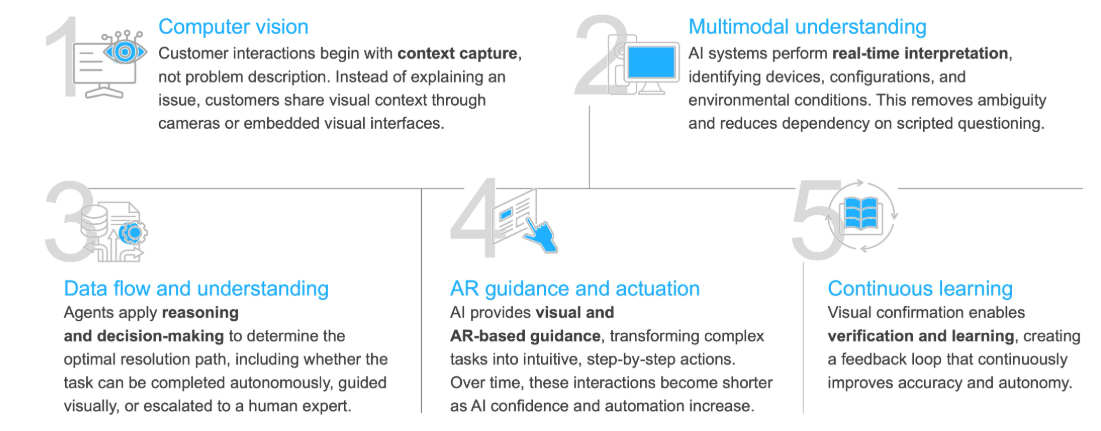 Where visual agents are expected to reshape enterprise workflows
Visual AI agents are finding use across various parts of a customer journey from initial product setup and onboarding, to troubleshooting and field service, and even in sales consultations. Below are key areas where they can transform CX significantly:
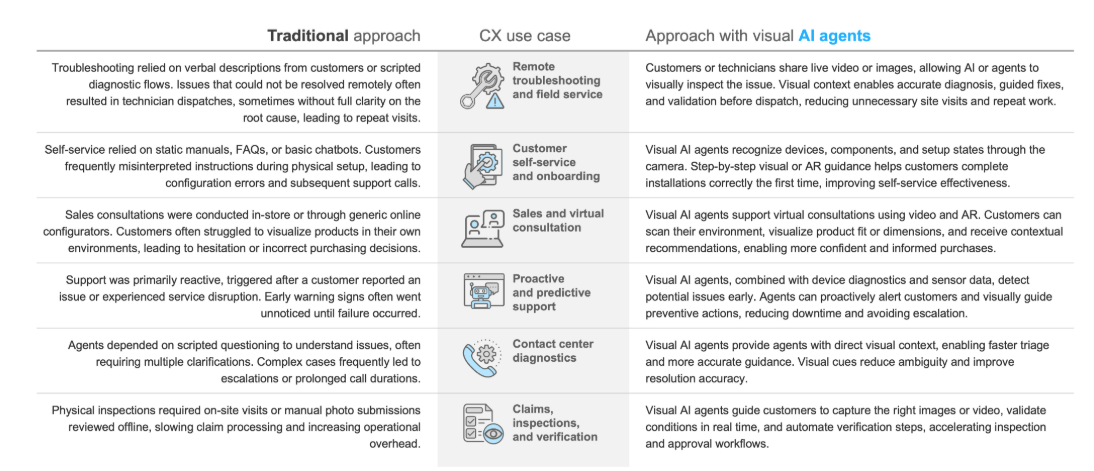
While these use cases demonstrate where visual AI can deliver value, it is also important to understand the architectural and operational requirements needed to scale this impact across the enterprises.
The evolution of visual AI agents toward enterprise-ready CX
Visual AI agents have progressed beyond early experimentation and are already delivering tangible CX outcomes across onboarding, troubleshooting, inspections, and remote assistance. Leading providers are moving beyond generic vision capabilities toward domain-trained visual models, pre-interaction visual data capture, and tighter orchestration between perception, reasoning, and execution. TechSee’s Sophie Live is a production-grade visual AI solution that combines real-time computer vision, generative AI, and multimodal reasoning to automatically see, identify, and help resolve customer issues from images or video. The solution continuously learns from interactions, improving accuracy and enabling enterprises to extend visual intelligence into self-service automation and agent assist contexts.
Notwithstanding the advances in the visual agentic AI space, today’s deployments also reflect the current boundaries of this technology such as:
- Variations in lighting, framing, and environmental conditions can reduce the accuracy of visual interpretation, particularly in uncontrolled customer settings
- Visual models generalize best to known devices and scenarios, requiring tuning for new variants
- Without tight integration into CX workflows, visual insights risk remaining non-actionable
- Differences in camera hardware, device performance, and network stability can affect the reliability and smoothness of visual interactions across users and geographies
With increased adoption of visual AI agents, technology providers will need to proactively establish robust data privacy, security guardrails, and design solutions that can adapt to emerging requirements around consent, data handling, storage, and governance.
As visual AI matures, success will increasingly depend on how effectively providers combine perceptual intelligence with orchestration, governance, and execution, setting the foundation for more autonomous, trusted, and scalable customer experience delivery.
Final thoughts
Visual AI agents represent a major advancement in the evolution of AI-enabled customer experience. By adding real-world perception to agentic reasoning, they will unlock new possibilities across self-service, contact center operations, and field service. They complement existing conversational agents by addressing tasks that require visual context and tasks that language alone cannot resolve effectively.
CX leaders who will treat vision as a first-class input alongside voice, text, and data will be able to redesign customer journeys around evidence, speed, and simplicity. The future of CX isn’t just smarter conversation. It’s visual intelligence at the moment of need and agents (human and AI) finally operating with the full context of the real world. Because when customers can show instead of struggle to explain, support stops feeling like a negotiation and starts feeling like a solution.
If you enjoyed this blog, check out The top 10 CXM predictions: how 2025 really played out – Everest Group Research Portal, which delves deeper into another topic relating to CX.
If you have questions or would like to further discuss how visual AI agents could reshape agentic customer experience models over the coming years, please reach out to Anubhav Das ([email protected]) or Akshat Bhargava ([email protected]).