
Blog
Marketing’s next operating model: Six shifts that will define the AI-driven enterprises

Leading enterprises have started moving decisively beyond edge level experimentation and toward rearchitecting how they design experiences, deploy technology, generate content, and measure value.
Looking ahead to 2026 and beyond, the conversation is shifting from which tool comes next to which operating model will unlock the next wave of value.
Reach out to discuss this topic in depth.
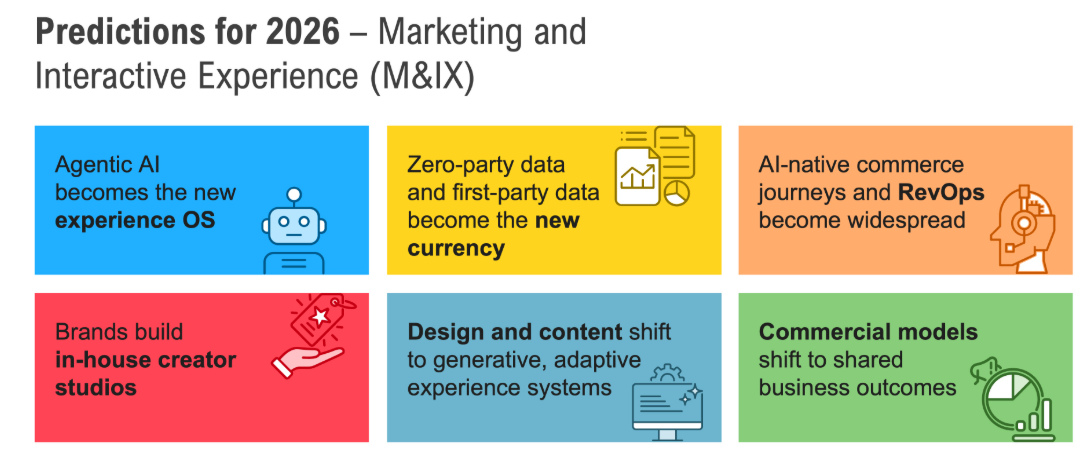
Our research across the M&IX landscape identifies six major shifts that will define this new model.
- Agentic AI becomes the new experience Operating System (OS)
Agentic AI will evolve into the orchestration layer that unifies today’s fragmented marketing ecosystem. As multi-agent workbenches mature, they will begin operating as enterprise command centers that coordinate tasks across content, media, analytics, Customer Relationship Management (CRM), and marketing operations.
What to expect
- AI workbenches emerging as the primary workspace for marketers, with specialized agents handling planning, execution, optimization, Quality Assurance (QA), and reporting
- Service providers productizing modular AI workbenches, offering configurable layers that integrate with existing MarTech and AdTech stacks
Why it matters
- Workbenches reduce tool fragmentation and create a unified operational layer across business functions
- Chief Marketing Officers (CMOs) gain clearer operational control, fewer execution inconsistencies, and improved Return on Investment (RoI) as manual coordination drops and workflows become more adaptive
- Zero-party data, first-party data, and loyalty become the new currency
As privacy regulations tighten and third-party signals continue to erode, brands will increasingly rely on direct data relationships with their customers. Zero-party data, openly shared preferences, motivations, and intentions, combined with first-party behavioral data, will become a core enterprise asset.
At the same time, loyalty programs will evolve from transactional point-and-reward systems to dynamic behavior engines that influence how customers engage, purchase, advocate, and return across the full customer journey.
What to expect
- Owned ecosystems becoming the primary data and personalization engine, with customers sharing richer preference and intent data through apps, loyalty programs, and interactive experiences when they see clear value in exchange
- Loyalty embedding across the full customer lifecycle as a behavior-shaping system, with models and metrics expanding beyond points and tiers to include engagement intensity, influence, intent signals, and ecosystem participation
Why it matters
- As third-party data continues to decline due to regulation and platform policies, organizations with strong first-party and zero-party strategies will outperform, delivering higher relevance, deeper trust, and greater lifetime value
- Loyalty becomes a strategic growth lever rather than a retention tactic, reducing reliance on paid acquisition, increasing share of wallet, and strengthening long-term customer relationships
- Brands build in-house creator studios
To meet demand for rapid, creator-driven content, brands will build their own internal creator studios. These studios will combine AI tools, influencer talent, and agile workflows to produce content at scale. Influencer platforms and specialized agencies will boom as brands increase investment in creator-led storytelling.
What to expect
- Enterprises building dedicated creator pods staffed with creators, editors, producers, social strategists, and content teams
- Hybrid studios combining AI and human creativity, enabling high-volume production with cultural nuance and brand governance
Why it matters
- Brands reduce production bottlenecks and gain speed by internalizing creative capabilities
- Community-led engagement creates deeper loyalty, stronger advocacy, and sustained brand relevance that cannot be achieved through paid media alone
- Design and content shift to generative, adaptive experience systems
Digital design is moving from static interfaces to dynamic, AI-generated experiences that adapt in real time. As AI accelerates content creation, advantage shifts away from producing more assets toward delivering experiences that respond continuously to user intent, behavior, and context.
As a result, content marketing evolves into context marketing. Rather than managing static assets, marketing teams orchestrate adaptive content systems across channels and discovery environments. Generative Enging Optimization (GEO) emerges as a discipline for shaping how these experiences are generated and surfaced in AI-driven discovery.
What to expect
- Experience systems that dynamically adapt in real time, with interfaces automatically adjusting layouts, flows, messaging, and visual elements based on behavioral and contextual signals
- Marketing teams moving from asset management to experience orchestration, adopting GEO practices and building content systems that continuously evolve rather than relying on static designs
Why it matters
- Adaptive experiences drive materially higher engagement and conversion, particularly in experience-led digital environments
- Generative systems lower the cost and effort required to build, test, and scale experiences, enabling personalization and experimentation without proportional increases in design and engineering resources
- AI-native commerce journeys and Revenue Operations (RevOps)become widespread
Commerce is moving away from linear funnels toward continuous journeys that unfold in the customer’s natural flow. As AI becomes embedded across platforms and workflows, commerce, marketing, sales, and customer engagement are increasingly designed as connected systems rather than separate stages.
Retail and enterprise platforms alike are expanding beyond transactions, blending commerce, media, insight, and execution into unified revenue environments.
What to expect
- Commerce platforms evolving into integrated growth environments, offering media, insights, creative tools, and closed-loop measurement that allow brands to plan, execute, and optimize campaigns alongside transactions
- Revenue execution becoming more coordinated and system-driven, with marketing, sales, and customer success operating under RevOps, aligned around shared data, AI-driven workflows, and lifecycle-level visibility
Why it matters
- Conversion opportunities increase when commerce meets customers in their native context, reducing friction and increasing purchase intent across the journey
- Connected revenue systems outperform fragmented models, improving velocity, conversion, retention, and overall customer value realization
- Commercial models shift to shared business outcomes
As AI automates production, clients expect agencies to tie compensation to measurable outcomes such as revenue growth, conversion improvements, retention lift, or efficiency gains. As a result, global delivery models will focus on measurable business impact rather than labor arbitrage.
What to expect
- Global delivery evolving toward outcome-led structures, with AI managing execution while providers compete on strategic value and measurable impact
- Service providers will build proprietary impact frameworks, offering standardized measurement models, attribution methodologies, and outcome dashboards to verify value
Why it matters
- Enterprises gain higher value from service partners who deliver measurable impact rather than capacity
- Aligning incentives strengthens trust and long-term partnerships, positioning service providers as true growth collaborators rather than execution vendors
Final thoughts
The predictions outlined above are not isolated trends but interconnected elements of an emerging operating model. Evidence across the industry suggests this shift is neither speculative nor distant; it is already underway. Leading service providers are signaling this transition through strategic investments.
For enterprises, the implications are profound: they must redesign how marketing and experience functions operate by building unified data foundations, integrating AI agents into workflows, engineering context as a strategic asset, and assembling modular MarTech architectures that can evolve continuously.
For service providers, the bar rises even higher. They must shift from execution partners to transformation partners through architecting multi-agent ecosystems, delivering implementation-heavy integration, and standing behind their work with outcome-based commercial models.
The winners on both sides will be those who treat these changes not as technological upgrades, but as an opportunity to fundamentally rewrite how experiences are created, delivered, and monetized.
If you enjoyed this blog, check out, Is Your Brand Ready to Be Quoted by AI? Welcome to GEO – Everest Group Research Portal, which delves deeper into another topic relating to marketing and sales.
To take the conversation forward, please contact Nitish Mittal ([email protected]), Divya Baweja ([email protected]), Aakash Verma ([email protected]), or Ravi Varun ([email protected])