
Blog
Future of workforce episode 2: The physical AI awakens
In our previous blog within the Future of Workforce series, we explored digital workers and what they mean for enterprises. In this episode, we shift from digital to physical- examining how physical AI agents are entering workplaces and reshaping work. In this series, we will unpack these critical shifts, exploring how enterprises can navigate them effectively, separate signals from noise, and understand their true long-term impact on the workforce.
Reach out to discuss this topic in depth.
Emergence of Autonomous Physical Agents (APAs)
For some years now, industrial robots have been limited to traditional use cases without much transformation such as fixed-path welding arms and pick-and-place machines built for speed and precision. These robots reliably handled repetitive tasks but operated in silos, following fixed scripts without the ability to adapt or collaborate.
With the rise of AI, intelligent automation is now moving beyond digital workflows into the physical workplace, giving way to physical AI agents, which we are terming as Autonomous Physical Agents (APAs) in this blog.
Earlier enterprise robotics vs. APAs
| Dimension | Earlier robotics | Autonomous Physical Agents (APAs) |
| Execution | Executed fixed, repetitive scripts | Adapt actions in real time based on environment |
| Ecosystem | Operated only in isolated factory zones | Function safely across offices, hospitals, retail, and warehouses |
| Interaction | Could not collaborate beyond a safe zone with humans and required fencing | Work safely alongside humans as cobots and service bots |
| Learning Capability | Had no learning ability and needed reprogramming. | Improve performance through reinforcement learning and self-assessment |
As a result, robots are evolving from back-office tools to frontline collaborators- shifting from R2-D2, the helpful sidekick, to Jarvis, the strategic partner. But what does this shift mean for the enterprise workforce? Which types of robots are gaining traction? What risks must leaders plan for? And how can organizations prepare for a future where humans, digital agents, and APA work side by side?
Why is APA momentum accelerating now?
Before we answer the complex questions above, let’s understand the market signals and reasons for acceleration. Recent advances in AI, vision, mobility, and low-cost sensors have made APAs safer and easier to integrate into operations. Further, the APA landscape is no longer driven solely by industrial automation vendors. Tech giants, chipmakers, automakers, and consumer electronics brands are now racing to build general-purpose physical AI systems.
Key signals:
- Tesla Optimus: Now performing autonomous object sorting, walking, and self-calibration, targeting manufacturing deployment
- NVIDIA GR00T & Project Jetson: Creating a foundation-model approach for embodiment, giving APAs rapid learning and simulation scaling
- Apptronik + NASA: Building human-safe multipurpose APAs for retail, supply chain, and manufacturing
Enterprise implication: If Tesla, NVIDIA, Samsung, OpenAI, and Apptronik are all building robots, enterprise leaders cannot treat APAs as a niche. Physical AI is becoming a strategic workforce pillar, not a factory-only experiment.
Key categories of enterprise APAs and use cases
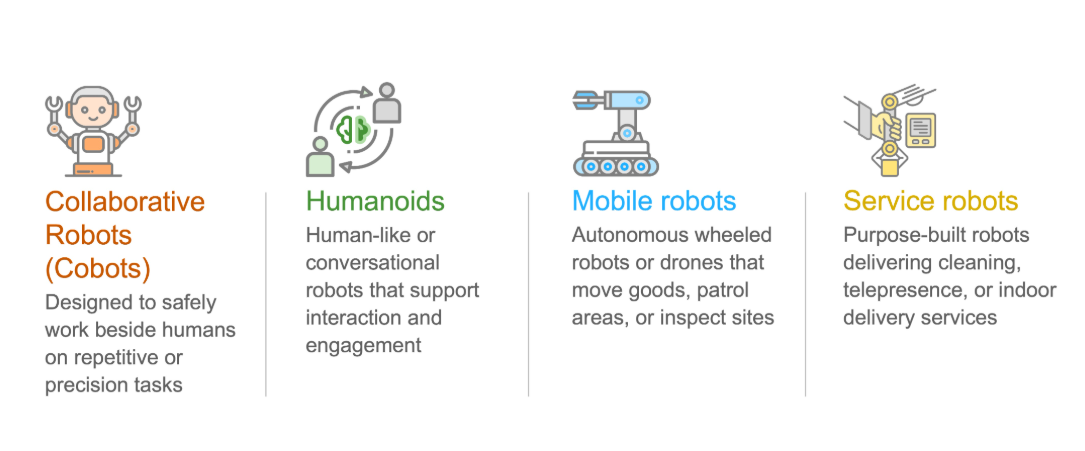
APAs span several categories of robots now entering mainstream enterprise environments. Below is a concise overview of the four most relevant types.
The table below highlights where these categories are starting to make a meaningful impact.
APAs across industries by category
| Industry | Cobots | Humanoids | Mobile robots | Service robots |
| Manufacturing | Assembly support, material handling (e.g., ABB YuMi) | Early pilots in R&D (e.g., Tesla Optimus) | Autonomous forklifts, inspection drones (e.g., OTTO Motors Autonomous Mobile Robot (AMR)) | Cleaning bots, mobile inspection units (e.g., Samsung Cleaning Robot) |
| Healthcare | Lab automation, pharma preparation (e.g., KUKA Med cobot) | Patient engagement, eldercare (e.g., Samsung Bot Care) | Medication transport robots, inter-campus drones (e.g., Zipline medical drone) | Telepresence robots (e.g., Temi 3 by Temi, a robotics company) |
| Retail | Robotic food prep, packaging support (e.g., Miso Robotics Flippy) | Customer greeters, in-store guides (e.g., SoftBank Pepper) | Shelf-scanning robots, delivery drones (e.g., Simbe, an Inventory robotics company’s robot Tally) | Autonomous cleaners, humanoid concierge (e.g., LG CLOi GuideBot) |
| Education | Lab-assist cobots in STEM programs (e.g., Universal Robots UR3e) | Social robots for tutoring or language learning (e.g., SoftBank NAO) | Campus security drones, delivery robots (e.g., Starship delivery robot) | Telepresence robots for remote students (e.g., Double Robotics) |
Beyond traditional robotic categories, new APA types are also gaining traction such as:
- Quadruped APAs for remote inspection, security patrols, and hazardous areas such as Boston Dynamics Spot
- Micro-APAs supporting pharmacy automation and lab precision tasks such as Mitsubishi Electric’s Micro-Factory Robots
Early deployments and setbacks
Not every APA initiative has delivered results. The following examples highlight the operational, commercial, and technical challenges that can hinder scaling:
| Case in point | What happened | Why It didn’t work |
| Amazon Scout delivery robot | Project discontinued after years of testing | Struggled with real-world complexity, scaling issues1 |
| Henn-na Hotel service robots | Hotel spent heavily on robot maintenance, but many robots failed or needed human help | Robots underperformed, created more work for staff, and couldn’t handle real customer needs2 |
| Serve Robotics delivery robot | Robots strayed from intended routes, raising safety concerns | Safety protocols failed in diverse real-world interactions3 |
| Knightscope security robot backlash | Security robots collided with people and faced public pushback | Cultural resistance and negative user reactions led to contract suspensions4 |
These cases show that APAs succeed only when deployment conditions- workflows, safety measures, Return on Investment (RoI), and user adoption are aligned. Without this foundation even advanced robots can underperform, causing delays and risks, while well-supported deployments scale more effectively.
Are you ready for APA deployment?
To scale APA, enterprises should ensure they can check SAFER off their readiness checklist through collaboration with the tech and service vendors:
SAFER roadmap for APA
| Foundation | Key action |
| Safety & compliance | Enforce robot safety standards (ISO 10218), conduct regular audits, and define clear incident-response protocols. |
| Alignment with work and workplace | Redesign processes for human–robot collaboration with clear task handoffs, create contextual simulations as per your industry vertical using digital twin technology. |
| Financial evaluation | Build ROI-based business cases, track cycle-time, quality, and labor metrics, and consider Robot as a Service (RaaS) models to manage costs. |
| Expertise & training | Upskill and prepare staff to operate and supervise robots, establish a robotics CoE, and fine-tune robot behavior using human feedback. |
| Regulation & governance | Set policies for robot usage, maintenance, liability, and retirement while ensuring compliance with labor, privacy, and drone/AV regulations. |
Beyond this checklist, enterprises must ensure system-wide integration and autonomy- meaning APAs should seamlessly interact with existing software and data. For example, in manufacturing, robots with embedded intelligence must integrate with Enterprise Resource Planning (ERP) systems, inventory and supply chain platforms, and production schedules to ensure streamlined end-to-end operations.
A phygital workforce is the way of the future
APAs are no longer experimental, they are becoming integral to factories, hospitals, offices, and retail environments. Their success will depend as much on people, processes, and governance as on the sophistication of the technology itself.
A phygital workforce, where human talent, digital agents, and APAs collaborate seamlessly, is the next stage of enterprise transformation. Organizations that invest proactively in readiness, safety, and change management will turn APA pilots into scalable, value-generating workforce partners.
Everest Group will continue to track these shifts through this series. To share workforce changes you’d like us to explore, please fill out this form Link.
If you enjoyed this blog, check out, From Metal to Mind: The Physical AI Revolution Redefining Robots as Partners – Everest Group Research Portal, which delves deeper into another topic relating to AI.
To discuss your workplace physical AI and APA strategy or for guidance on scaling up your “phygital” workforce, reach out to: Prabhneet Kaur ([email protected]), Nishant Udupa ([email protected]), Rohit Narain ([email protected]).
Sources