
Blog
The future of AI in telecom: why domain-specific models are winning

But within that cohort, a distinct pattern separates market leaders from laggards, and it comes down to one strategic choice: choosing the right Large Language Model (LLM) model architecture for different operational domains.
Reach out to discuss this topic in depth.
The market shift: from exploration to execution
After years of experimentation and Proofs-of-Concept (PoCs), operators worldwide are moving from strategy to execution, deploying AI solutions that deliver measurable business value. Customer care dominates deployment activity, representing nearly half of all AI implementations. Network-related applications follow closely, including predictive fault detection and performance optimization.
However, despite this growing adoption, a critical execution gap has emerged, with not all AI initiatives meeting expectations. The execution gap persists because operators conflate two distinct challenges: broad business transformation (customer service, content) and mission-critical systems optimization (network intelligence, configuration). Each requires fundamentally different model architectures.
When telecom operators deploy general-purpose models on Third Generation Partnership Project (3GPP) standard interpretation tasks, accuracy drops to 60-70%. Domain-specific fine-tuning raises this to 90-95%. As emerging market evidence shows, the AI strategy is not singular but dual-natured, as the exhibit below shows. Understanding this distinction is vital for telecom executives navigating AI transformation.
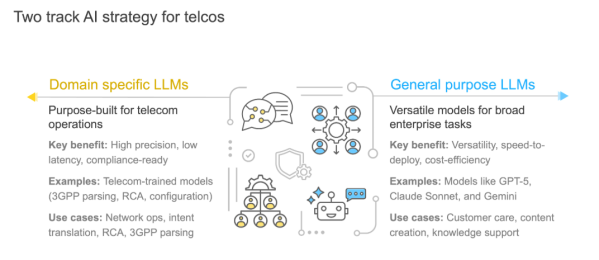
We take a closer look at the two LLM tracks below.
Track 1: General-purpose LLMs for broad applications
The first track involves deploying general-purpose frontier models. Recent data from the GSMA Open-Telco LLM initiative confirms the GPTs, Claude Sonnet models, and Gemini variants excel in broad, versatile applications. For use cases spanning diverse customer inquiries, content generation, and employee productivity, general-purpose models remain unmatched, but this versatility comes at the cost of latency, cost per inference, and data sovereignty that mission-critical telecom operations cannot tolerate.
Track 2: Domain-specific models for mission-critical operations
The second and increasingly strategic track focuses on domain- or task-specific models purpose-built for telecommunications operations. These specialized models are proving transformative for network troubleshooting and diagnostics, configuration management and automation, intent-to-configuration translation for network orchestration, standards interpretation of complex 3GPP and the Institute of Electrical and Electronics Engineers (IEEE) specifications, and root-cause analysis of network incidents using telemetry data.
This is where the business case for domain-specific models becomes compelling. For network troubleshooting, a 200ms latency difference between a cloud Application Programming Interface (API) general model and an edge-deployed specialized model can mean the difference between detecting a cascading failure in seconds vs. minutes, translating to millions in avoided Service Level Agreement (SLA) penalties.
Why domain-specific models are gaining strategic priority
While general-purpose models offer impressive capabilities, the telecommunications industry’s unique requirements are driving a decisive shift to specialized models for core operational functions. The business rationale is grounded in four critical factors: cost, performance, speed, and operational control. When tasks require rigid schema adherence, standards compliance, and structured configuration logic, domain-specific fine-tuning delivers targeted advantages that raw scale cannot match.
Smaller models optimized for specific tasks deliver lower latency that is essential for real-time network operations, edge computing applications, and customer-facing systems.
Data sovereignty and compliance advantages are equally important. Domain-specific models deployed on-premises enable telecom enterprises to maintain data within their security perimeters, avoiding the compliance risks associated with third-party cloud APIs. Beyond the Global Telco AI Alliance (GTAA) collaborative effort, several telecom-specific models have emerged as benchmarks for domain specialization. While alliances like the GTAA are setting up early benchmarks for telecom-specific AI models, the next challenge lies in translating innovation into scalable, secure deployment. This transition introduces a fresh set of implementation hurdles that operators must address strategically.
The challenges operators face in implementation
Despite compelling advantages, domain-specific telecom LLMs present significant challenges that operators must navigate strategically, including:
- Data quality and management: Fragmented systems slow model training and accuracy. Operators must invest in data infrastructure modernization, semantic clarity, and robust data governance frameworks
- Regulatory compliance: General Data Protection Regulation (GDPR) and other industry-specific frameworks require strict data governance and transparency. AI systems must ensure algorithmic transparency, data anonymization, and robust security measures
- Integration complexity: Integrating AI models with legacy Operations Support Systems (OSS) and Business Support Systems (BSS) presents significant technical challenges. Successful implementation requires cross-system integration, API standardization, and careful change management
- Skills and readiness: The shift to AI-driven operations demands new organizational capabilities. Beyond technical skills, successful AI adoption requires cultural transformation, training and upskilling, and maintaining appropriate human oversight
- Return on Investment (ROI) uncertainty: Domain-specific models can lower costs over time, but upfront spend is significant, depending on complexity. The key is starting with focused, high-impact use cases that deliver measurable business value, then scaling systematically
For telecommunications executives navigating AI transformation, the mandate is clear: adopt a dual-track strategy, leveraging general-purpose models for versatility and domain-specific models for precision.
To unlock true business value, telecom enterprises must go beyond experimentation and build AI-ready foundations, robust data pipelines, strong governance, and seamless system integration. By sequencing high-impact use cases that deliver measurable RoI and embedding compliance, security, and human oversight from the start, operators can turn AI from a one-off innovation into a repeatable, scalable advantage.
Operators that execute this dual-track strategy by 2026 will lock in a 5-7-year efficiency advantage over peers across telecom operations and go-to-market execution. Those that delay will face compounding disadvantages as competitors leverage domain-optimized models to capture margin and velocity. Those that master this balance of breadth and depth, innovation and control will not only optimize existing operations but also create new revenue streams and competitive differentiation as AI reshapes the telecom landscape through 2030 and beyond.
If you find this blog interesting, check out our report, IT Services for Telecom State of the Market 2025 – Everest Group Research Portal.
If you have questions, would like to gain expertise in AI adoption in telecom, or would like to reach out to discuss these topics in depth, contact Titus M at [email protected] or Nithya S at [email protected].